

Free Unit Study for AAPI Heritage Month

If you’re like me, sometimes you and your homeschoolers need a break from the routines to do something fun (but educational). This could be:
Filling time over the summer when the weather is too awful to go outside and have fun
Helping homeschool high schoolers log some extra hours for Social Studies electives or leveling up a World History credit
Just for fun, any time of year
Here is a Unit Study for the family with East Asian Themes
This unit study is interactive with reading/literature, movies, and hands-on activities for all homeschoolers. This is a collaboration between our friend, Samantha, at Learn in Color. We have always loved Samantha’s resources and are so excited to create a whole-family unit study together.
Note: For homeschool high schoolers, you can log hours for activities and keep book lists so that appropriate credit can be given. (More details later in this post.) For information on logging hours, see this post.
Goals for this unit study:
In this unit study, we will experience an overview of the geography, literature, and culture of these East Asian countries:
China
Japan
South Korea
The goals of this unit study include:
Enrich our homeschoolers’ awareness of the history and cultural significance of these East Asian countries
Aid growth in understanding these East Asian countries’ histories
Add interest and richness to homeschool curriculum
Also, give teens useful educational opportunities for leveling up their Social Studies or ELA credits
BTW: The term “unit study” is another way to describe integrated learning. If you would like a more in-depth discussion on how to create integrated learning experiences for your teens or homeschool co-op, check out this post.
Curriculum needed
For the family:
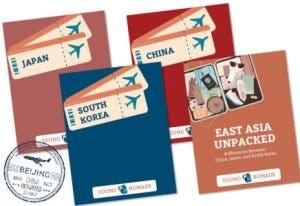
Young Nomads: East Asia from Learn in Color
Note: Young Nomads includes a suggested booklist for students of various ages. These books can usually be obtained at the library or from an online bookseller.
For high schoolers:

Note: For families in states that reimburse for curriculum, here is a link to The Good Earth Literature Study Guide that is acceptable for reimbursement.
For families with high schoolers and younger students:
Read the provided introductory materials to each country to the whole family
Many of the books in the Young Nomads guides make WONDERFUL read alouds for the whole family
Watch some of the suggested movies and videos from Young Nomads
Journal on the provided journaling pages from Young Nomads
Work together on hands-on games, projects, activities, and cooking
Methods for High School Students:
Participate in family activities
Read The Good Earth by Pearl S. Buck and complete 7Sisters Literature Study Guide. Also, to enrich your booklist, add reading from the suggested booklist in Young Nomads (although many of the books are good for middle school and younger, many of the middle school books are also good choices for high school)
Writing essay, report, research paper or short story (or combination, according to student’s goals) about one of more topics of interest
Journalling about what they learned or thought about as the read the novel or participate in activities
Time Frame
The time needed for this unit study will be adjustable:
Two or more weeks for families who are interested in the books, movies, activities and want to explore more
One week or less for if you simply need to choose some books or activities to enrich curriculum
Grading
Grading for teens will be by assignment, with the assignment’s grades going toward the total grade for the student’s ELA, American History, Science or Fine Arts totals.
Books:
Literature Study Guide (follow parent answer key for the 7Sisters Literature Study Guide) OR one-page book summary or reflection paper
Writing assignments:
Grading by rubrics given in 7Sisters materials
Journaling:
Grading by participation (did the student record some thoughts in the journal?)
Fine Arts:
Grading by participation (was the project completed?)
Guided discussion (optional):
Grading by participation (did the student participate?)
Download this freebie for grading with rubric and how-to.
The book can be read in various formats:
Traditional book form
Audio book
Family read-aloud where appropriate
Additional East Asian reading to enrich the study
There are lots of good reading suggestions in Young Nomads. (Please note that in the book suggestions, the novel To Catch a Tiger is delightful, but has one edgy secondary character relationship.)
Optional additional reading of East Asian-themed literature (add to the book list)
Books about Korea by Linda Sue Park:
A Single Shard
When My Name Was Keoko
Hiroshima by John Hersey
History
History for each country is in the form of an informative and interesting article in the Young Nomads bundle.
Documentaries, Movies, and Videos
Are listed in Young Nomads bundle
Young people and teens enjoy: Korean Word of the Week on YouTube
For high schoolers who want to earn a high school credit, we have enjoyed: Talk to Me in Korean
Writing
Younger homeschoolers:
In Young Nomads, choose from the “Bingo Schedule” of writing and journaling activities.
High schoolers
Work through 7Sisters World Poetry: Reading and Writing. (For families in states that reimburse for curriculum, here is a link to World Poetry: Reading and Writing, which meets those requirements.)

Fine Arts, Culture, and Cooking
Choose activities provided in Young Nomads.
********************************************************************
Syllabus for the Unit Study: East Asian Theme
For family time and younger students, follow the Schedule in Young Nomads East Asia Outline PDF.
For high schoolers, participate in family activities as fits your needs and schedule, plus:
Daily for China
ELA Literature:
Read The Good Earth. Discuss with your parents how much you should read each day. Follow along with the questions in 7Sisters The Good Earth Study Guide.
ELA Writing plus History:
Choose a topic from family activities and write a journal your thoughts, or choose one of these prompts:
What differences do you see between Chinese and American culture?
What similarities to you see between Chinese and American culture?
What is something you would like to learn more about? Why?
Fine Arts and Culture:
Participate in family activities from Young Nomads. Explore anything that catches your interest with further projects.
Daily Wrap Up
Be sure to log hours on all the activities above.
End of day discussion. Discuss the questions together. Do you have any thoughts you would like to discuss or explore?
Daily for South Korea
ELA Literature:
Read a suggested book with a Korean theme. Discuss with your parents how much you should read each day.
ELA Writing:
In World Poetry: Reading and Writing, start with Week 1: Poetry of Korea, Sijo. Work on the daily assignments as laid out in the workbook.
History:
Watch one of the suggested movies or documentaries on Korea.
Fine Arts and Culture
Participate in family activities from Young Nomads. Explore anything that catches your interest with further projects.
Daily Wrap Up
Be sure to log hours on all the activities above.
End of day discussion. Discuss the journaling questions together. Do you have any thoughts you would like to discuss or explore.
Daily for Japan
ELA Literature:
Read a suggested book with a Japanese. Discuss with your parents how much you should read each day.
ELA Writing:
In World Poetry: Reading and Writing, start with Week 2: Poetry of Japan, Haiku, Senryu, Tanka. Work on the daily assignments as laid out in the workbook.
History:
Choose a documentary or movie suggested in Young Nomads.
Fine Arts and Culture:
Participate in family activities from Young Nomads. Explore anything that catches your interest with further projects.
Daily Wrap Up
Be sure to log hours on all the activities above.
End of day discussion. Discuss the journaling questions together. Do you have any thoughts you would like to discuss or explore?
Any additional weeks devoted to Young Nomads
ELA Literature:
Choose a suggested book about any of the countries.
ELA Writing:
Continue working through World Poetry: Reading and Writing. (Although these will not be lessons about East Asia, they are good to know.)
History:
Choose a documentary or movies from the lists suggested in Young Nomads.
Fine Arts and Culture:
Participate in family activities from Young Nomads. Explore anything that catches your interest with further projects.
Daily Wrap Up
Be sure to log hours on all the activities above.
End-of-day discussion. Discuss the journaling questions together. Do you have any thoughts you would like to discuss or explore?